Dear AI, it's time to see disability properly.
Can you remember a time before AI? Although artificial intelligence has only become part of everyday life in recent years, it already feels like it is taking over. We use it to gather ideas, organise our thoughts, create content and even seek advice on everything from work and health to travel and daily life.
Millions of people now use AI image tools to create everything from fun portraits of themselves as superheroes to visuals for work presentations, campaigns and creative projects.
However, within all this, something important is being missed.
AI does not always represent the world as it truly is: diverse, varied and filled with different bodies, identities and underrepresented communities.
And when it comes to disability, there is a significant problem.
As someone who has only ever known life with a limb difference, I know what it feels like not to be visible in everyday life.
Growing up in the 1980s and 90s, there was very little awareness or visibility of people like me. Disability and difference were rarely shown on TV, in sport, in fashion, in campaigns, or simply in everyday life.
I often felt like the only amputee in a world that was not designed for me.
And that is not a healthy message for anyone to grow up with. Future generations of people with limb loss, limb difference and disabilities deserve to feel included in society, not left out of the story again.
The problem is not the intent; it is the absence.
AI is not misrepresenting disability on purpose. It can only learn from the information, images and descriptions it has been given, and there have not been enough accurate representations of people with limb loss and limb difference in the data AI has learned from.
But we have an opportunity to change that.
As AI becomes part of the next major shift in society, we have a chance to guide what it learns. Through real pictures, photo descriptions and authentic lived experiences, our community can help teach AI what disability actually looks like — from the people who understand it best.
AI may be advancing quickly, but when it comes to disability, it still has a way to go.
When AI misrepresents disability
When AI attempts to create images of people with limb loss, limb difference or visible disabilities, the results are often inaccurate.
Mobility aids, prosthetics and other aspects of real-life diversity are often missing, distorted or inaccurately portrayed. Prosthetic limbs can appear unrealistic. Hands, feet, sockets, prosthetic components or mobility aids may be shown incorrectly. Sometimes a limb difference is exaggerated in a way that feels uncomfortable or unrealistic. Or AI erases it and replaces it with a limb that is not there.
These mistakes may seem small to someone outside the community, but to those of us who live this every day, true representation matters.
Disability is not a costume, a concept or a rough idea. It is real bodies, real movement, real equipment, real adaptation and real lives.
When AI gets those details wrong, it can make people feel excluded all over again.
Real images. Real people. Real lives.
That is where Dear AI comes in.
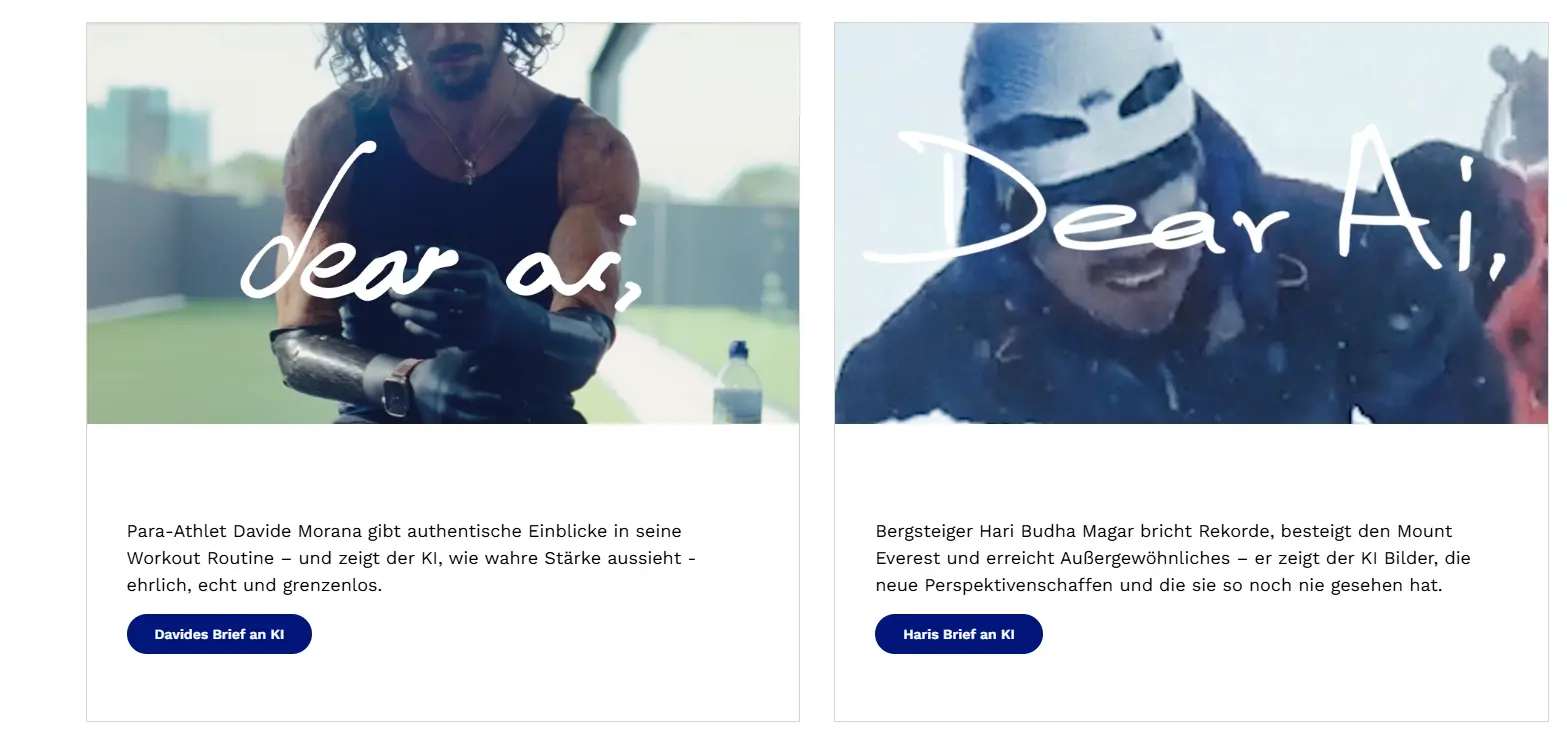
Dear AI, the Ottobock campaign powered by Microsoft technology is helping create a more authentic dataset for training AI systems — from the real lives of our community to AI.
Dear AI is inviting Movao community members to contribute to this new AI narrative by sharing photos of themselves simply being themselves, along with photo descriptions that help AI learn directly from their lived experience.
There is no one way to be an amputee. There is no single body, prosthesis, mobility aid, lifestyle, background or story that represents everyone.
That is exactly why a wide range of real images is so important.
A photo of someone walking their dog tells one story. A photo of someone playing a sport tells another. A photo of someone cooking dinner, travelling, working, parenting, resting, laughing with friends, using a prosthesis, or not using one, adds something different.
These everyday moments matter because they show disability as part of real life, not something separate from it.
They help AI understand context: how prosthetics are worn, how people move, how mobility aids are used, and how people with limb loss and limb difference show up in both ordinary and extraordinary ways.
Why your contribution counts
Your photo might feel like just one image, but together, these images can help build a more accurate picture of our diverse and vibrant community.
We are not incomplete. We are part of everyday life.
By getting involved, Movao members can help shape a digital future where people with limb loss and limb difference are represented more accurately, naturally and respectfully.
AI is still learning.
If AI is going to represent us, it needs to learn from us.
And this is our chance to help make sure it sees us properly.
How to get involved? Send us your photos and/or videos to [email protected].
That's all. 🏆 We will upload them to the Dear AI Community Library, helping AI learn to represent our community more accurately and more humanly.
Please don’t worry, your images will remain private and will not be shared anywhere else.
If your files are large, please contact us ([email protected]) and we will send you a folder where you can upload them.
Learn more about the Dear AI campaign now