
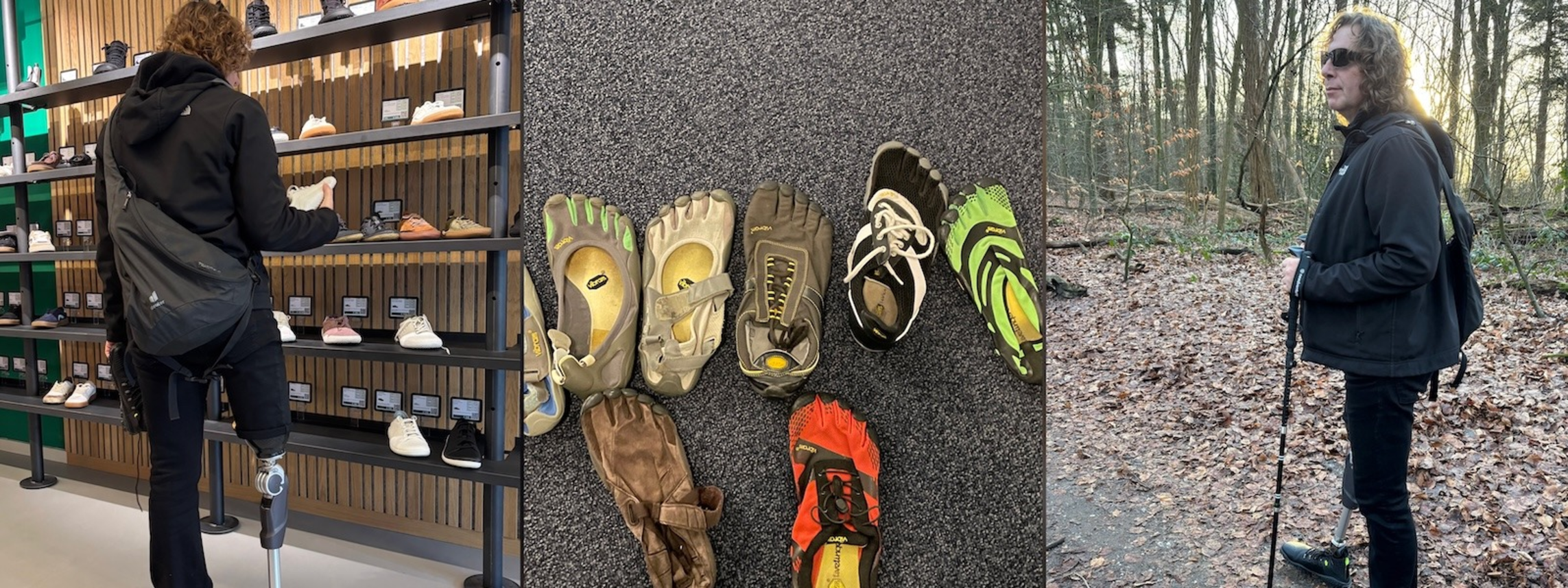
Barefoot shoes: a game changer for amputees
Published on January 27, 2026
During rehabilitation after amputation, learning to walk with a prosthesis is a big focus — but it’s not the only one. Attention is also given to the rest of the body, with fitness and core strength playing an important role. Once rehab ends, it’s then up to you to keep building on that.
Understandably, there’s also a lot of focus on prosthetic technology and the options available. Mechanical knees, electronic knees, different feet, blades, bathing and swimming prostheses — so much has changed over the years. I’ve even had other amputees tell me to “just get a microprocessor knee.” Sadly, it’s not quite that simple in the Netherlands (unless you have €40,000 spare 😂). For now, though, my mechanical knee allows me to do everything I want. I’ll go into the pros and cons another time.
What’s talked about far less is how much the rest of your body has to compensate. Every amputee deals with this in one way or another — and I suspect age plays a part too 😏. Since my amputation, I’ve noticed more issues with my lower back and neck. The neck problems mainly show up at night: when I lie on my side, I’m never fully balanced anymore, so my neck ends up in an awkward position. I try to fix that by placing my leg on a pillow, but I move a lot in my sleep… so it doesn’t always work.
My lower back has taken a hit, too, especially during periods when I wasn’t walking in balance on my prosthesis. Thankfully, that’s improved as my walking has become more confident and I’ve kept up with my core exercises. My left leg has to do a lot of the work — my stump has far less muscle and strength — but as I’ve got stronger and moved better, that’s gradually become easier.
Where I really started noticing problems was in my left foot. It’s the only foot I still have — or at least the only one I still have feeling in 😂 — so it ends up doing all the balancing work. My second toe is longer than my big toe, which means it’s constantly bent. I had the same issue on my right foot, but that’s obviously no longer relevant. To take some pressure off, I’ve been using a silicone pad under that toe for a while now.
A few months ago, during my second fall, I bent my big toe backwards. Since then, I’ve had symptoms that fit with hallux valgus or hallux rigidus — self-diagnosed, but confirmed by my physio. Using a toe spacer during rest helps a little. And then there’s my Achilles tendon. Since I started running again with a blade, an old running injury that had been quiet for about 15 years has returned. Considering the impact and imbalance it has to deal with, that wasn’t entirely surprising. Compression socks have now become part of my routine, too. So yes… the collection of little aids for various aches and pains has quietly started growing again 😂
Some of this, I realised, came down to footwear. I learned to walk on my prosthesis wearing one specific type of trainer, and because that worked well, I bought three pairs in different colours. I didn’t dare try other shoes — I was afraid of tripping or falling. My prosthetist, Arno, had also set my foot up specifically for these trainers. I have a very active prosthetic foot, which suits my lifestyle, but it isn’t adjustable for different types of shoes.
Over time, though, I noticed that while these trainers are comfortable, my left foot starts hurting after about 5 km. They’re simply too soft, with soles that are too thick — fine for daily life, but not for longer or more demanding walks. I’d already been thinking about traditional hiking boots when I received a tip from Movao editor Rebecca Legon to try Barefoot shoes — something she’s found hugely beneficial herself.
I also realised I finally felt confident enough to experiment with different shoes again. Years ago, I loved walking in Barefoot shoes — especially FiveFingers —, but I’d stopped because my knee no longer tolerated them very well. Rebecca’s suggestion reignited that curiosity.
So I decided to test this out at home first. I started wearing Barefoot shoes I’d previously received from my PT, Kiethton. Sometimes I even wore a FiveFinger on my left foot and nothing on my prosthetic foot apart from the silicone cover. What I noticed fairly quickly was that my left foot began to relax — it didn’t have to compensate as much. The aches reduced, and these days I rarely wear shoes indoors at all.
One thing did become clear, though: my prosthetic foot was still angled slightly upwards at the toes, set up for thick-soled trainers. I asked my prosthetist, Arno, if he could adjust it to a more neutral position so it would work better across different footwear — and even Barefoot. That change made a noticeable difference.
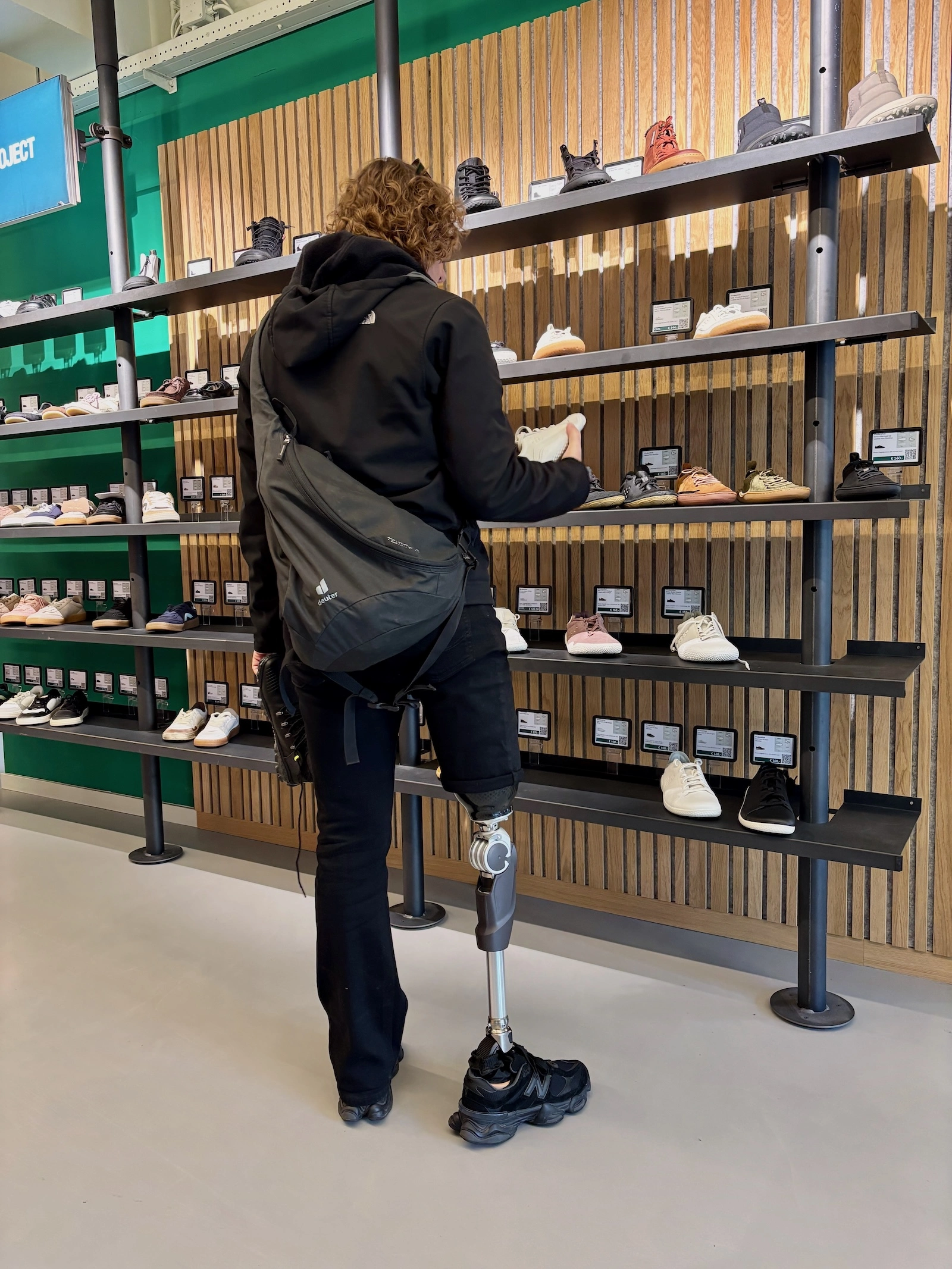
With that extra confidence, I decided to properly explore Barefoot shoes. The market has grown enormously. We visited Barefoot and More in Arnhem, a shop specialising only in Barefoot footwear. After trying lots of different options, I chose two pairs: a thin-soled sneaker with a wide forefoot for everyday use, and a mid-height VIVO Barefoot hiking boot with more grip for uneven, muddy terrain.
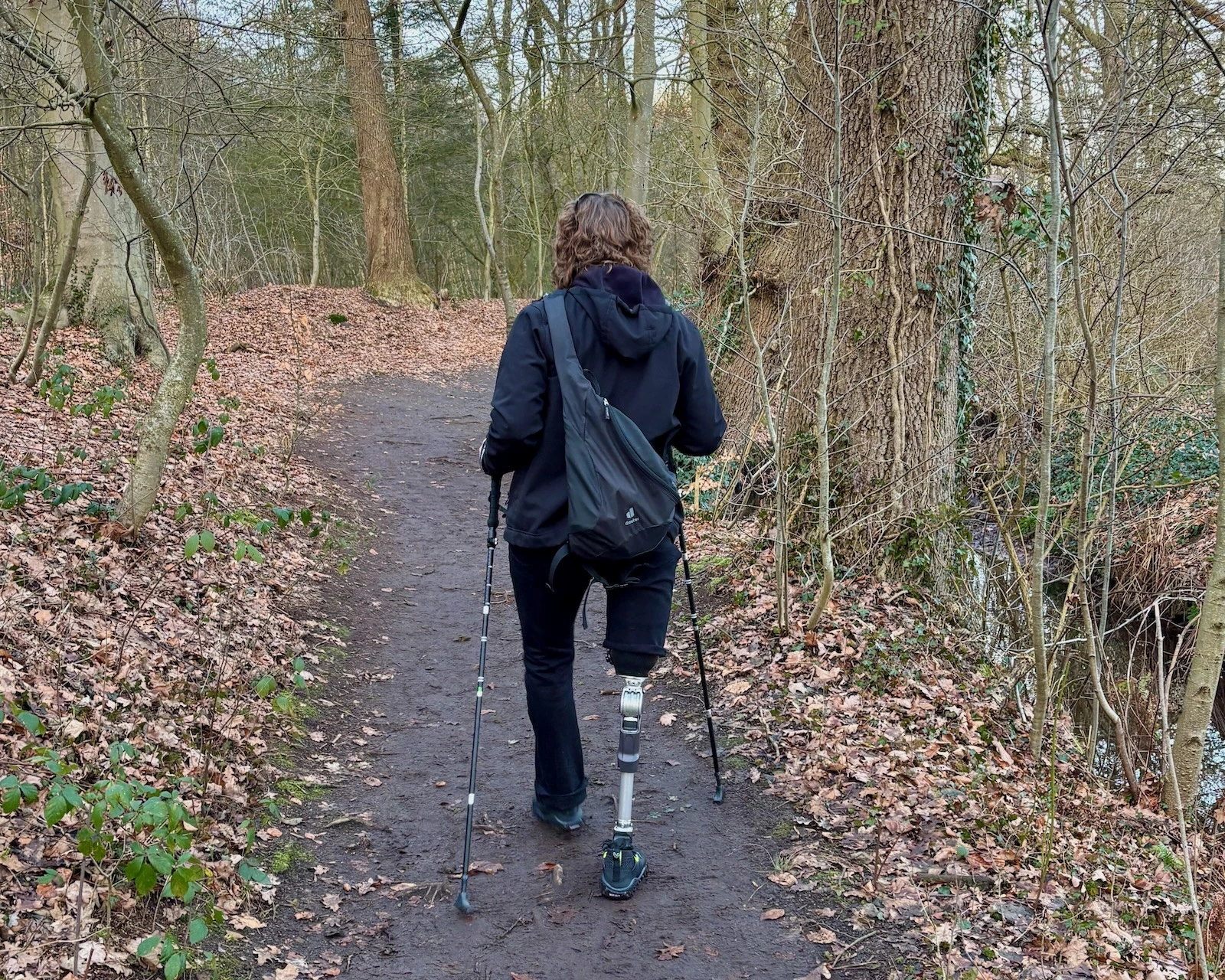
I tested the hiking boots straight away in the forests near Renkum — and they felt great. That familiar barefoot sensation returned, even with my prosthesis. In fact, they felt better than thick, cushioned soles. The pain in my feet and lower back reduced noticeably.
When I return to Rijndam soon for a new socket (my current one is already too big again — details matter, but that’s another blog), I’ll ask Arno if we can make the foot even more neutral to support barefoot walking further.
If I’m completely honest, though, I’d love to go back to wearing my FiveFingers. I still own several pairs. My prosthetic foot only has the big toe separated, so they don’t fit — but another idea was to cut the toe sections open on the side. Otherwise, they’d go unused anyway. So I tried it. And now, at least at home, I’m back walking in my FiveFingers — and loving it.
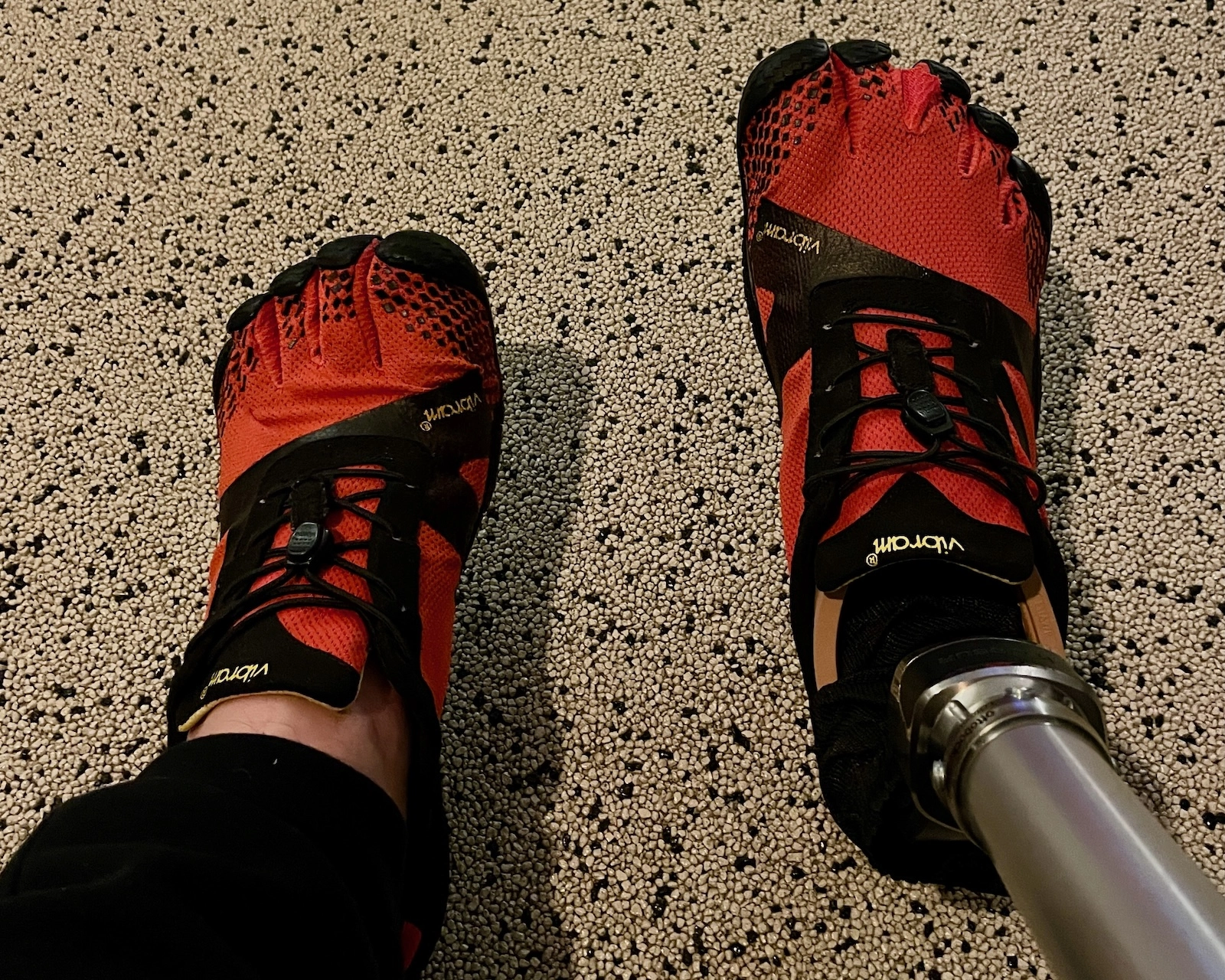
Best of all, the pain in my left foot and Achilles tendon has reduced, meaning fewer supports are needed again.
One song my psychologist, Karin, once suggested for my playlist feels more fitting than ever now: Dancing Barefoot by Patti Smith 😉
I’ll still wear my colourful trainers — I love them far too much not to — just not every day, and not for long walks.
This whole experience has reminded me how important it is to care for the whole body, not just the stump or prosthetic technology. What works will be different for every amputee.
And whether FiveFingers are aesthetically pleasing… well, that’s debatable 😂 I’ve been stared at plenty of times for wearing “weird toe shoes,” but with my prosthesis already visible, I’ve simply swapped one unusual foot for another.
Next up: my goals for the year.
See you soon,
Movao Warrior: Chris Kunkeler
Movao Warrior: Chris Kunkeler