
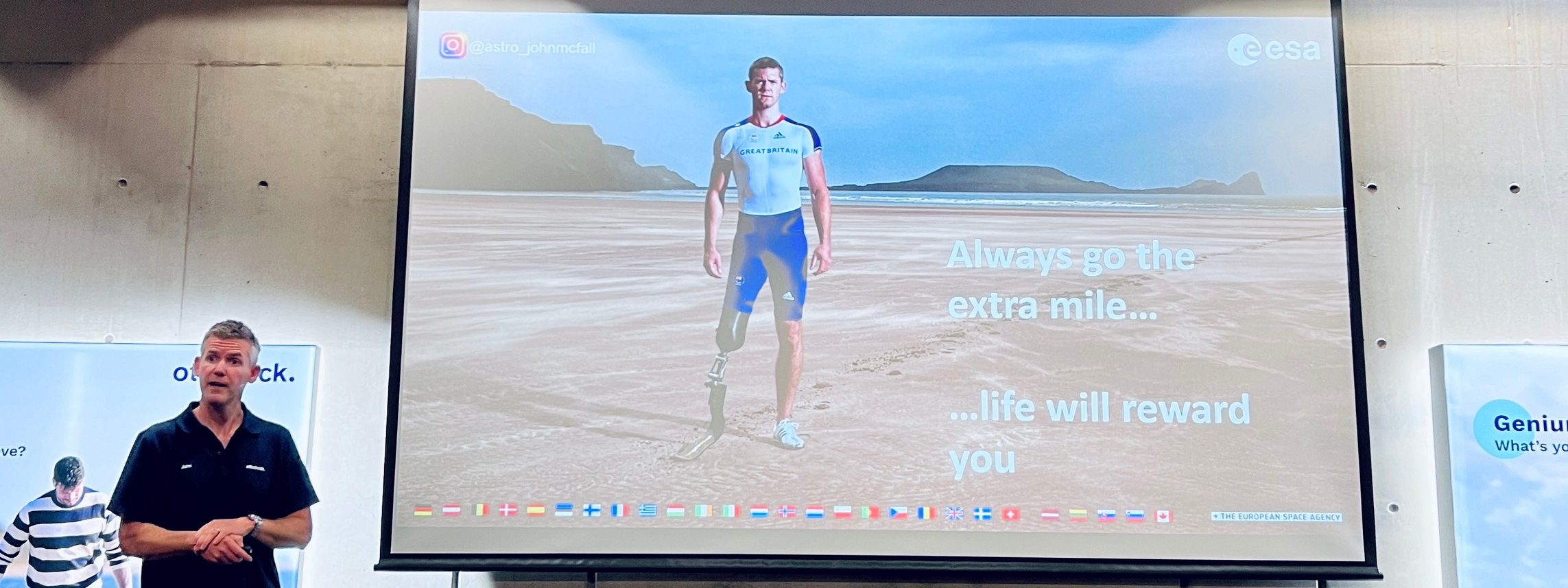
Get out of this world! How John McFall is taking prosthetics into space
What happens when a sprinter, a surgeon, and a space enthusiast walk into a room? Simple: you get John McFall. The former British Paralympic medallist, orthopaedic doctor, and now Europe's first astronaut reserve member with a physical disability is determined to blast through barriers—straight into space.
John's journey through amputation
I recently attended the Genium X4 launch where John presented his fascinating life story. He spoke about his military family background, passion for sports, and early ambitions of joining the British army. Before committing to that path and going to university, he sought adventure and set off to explore Indonesia, Southeast Asia, Australia, and New Zealand. But while riding a motorcycle in Thailand at 19, he lost control on a corner—an accident resulting in a significant vascular injury leading to the amputation of his right leg.
During his talk, John shares a photo of himself mid-air, leaping from a cliff—a moment of freefall that mirrored the emotional plunge he felt after his accident. It symbolized the uncertainty and fear he faced in those early days. Reflecting on that time, he says: "Oh no, what am I going to do now? I had my life planned out in front of me, and suddenly, I was thrown into this new life without direction or any idea of what would happen next. I was scared and a bit lost."

On returning to the UK, John began rehabilitation at Roehampton's Douglas Bader unit. It was a tough time, both physically and emotionally. He recalls one night in particular when grief overwhelmed him: "I remember all this turmoil and emotion, and one night I couldn't sleep for crying—absolutely sobbing—and I found myself curled up on all fours, overwhelmed by grief."
At that moment, he described himself as not creative but wrote a beautiful poem titled Opportunity. The final lines read:
"As my tears dash this page,
they are not of sadness, regret, despair, nor guilt
but madness to have overlooked
the fact that my heart is still beating
and from behind the doors which I am now reaching,
opportunity arises."
This cathartic process helped him realize that he alone held the power and responsibility to create the conditions for a happy and fulfilling life.
Finding freedom in sports again
Determined to reclaim his identity and love for sports, John yearned to run again. He threw himself into training, describing those early runs as an amputee—long before today's advanced prosthetics—as: "Clumsy, uncomfortable, noisy, and awkward, but I didn't care. I was running again, and I was making progress."
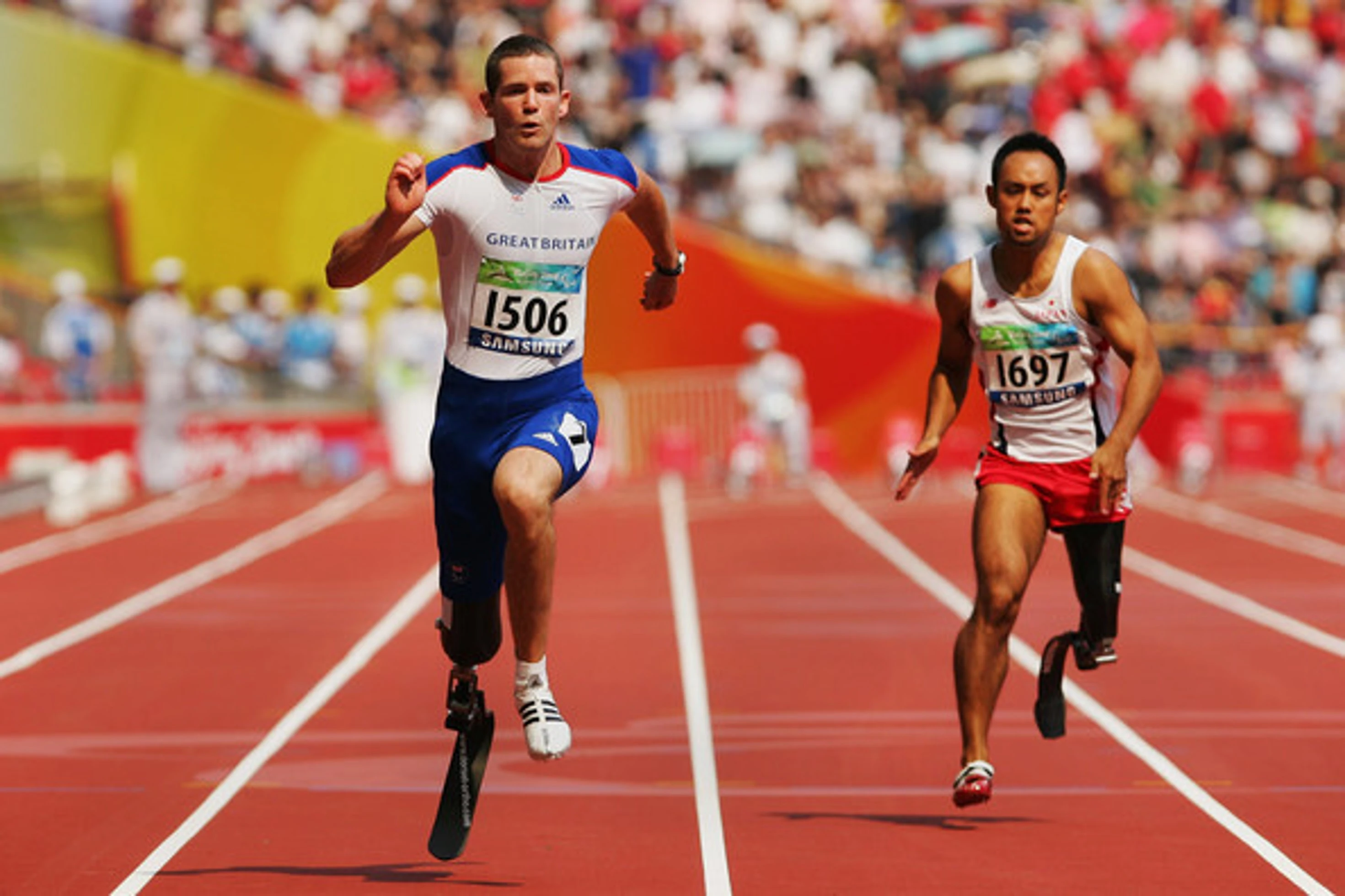
That mindset sparked an incredible comeback. A few years later, John represented Great Britain in the Paralympics, class T42, winning a bronze medal in the 100m sprint at the 2008 Beijing Games. However, for John, it was never just about winning a medal— what was far more important for him was his personal growth, perseverance, and proving what he could achieve with hard work and determination.
He talks about his most overriding feeling upon crossing the finish line in Beijing: "It was the emotion of relief—that it was over. Relief that I didn't have to think about this competition anymore, as the weeks and months leading up to the event consumed so much mental and physical energy. Coming away with a medal was great, but the most important thing I discovered about myself is that I could do it, even though it petrified me."
From sprinting tracks to space tech
After retiring from athletics, John studied medicine and became a trauma and orthopaedic surgeon. But in 2022, he took on a new adventure: the European Space Agency (ESA) was seeking a candidate with a physical disability to join the ESA astronaut reserve.
John applied—joining thousands of applicants from across Europe—and passed the ESA's scrupulous and highly competitive selection process, which includes rigorous physical, psychological, and technical testing. Out of all the candidates, he was successful—and made history as the world's first person with a physical disability to be selected by a space agency.
His new mission wasn't just about sending astronauts with physical disabilities into space by completing training and learning how to live and work in space; it also came with a new challenge of making his prosthetics space safe and ready.
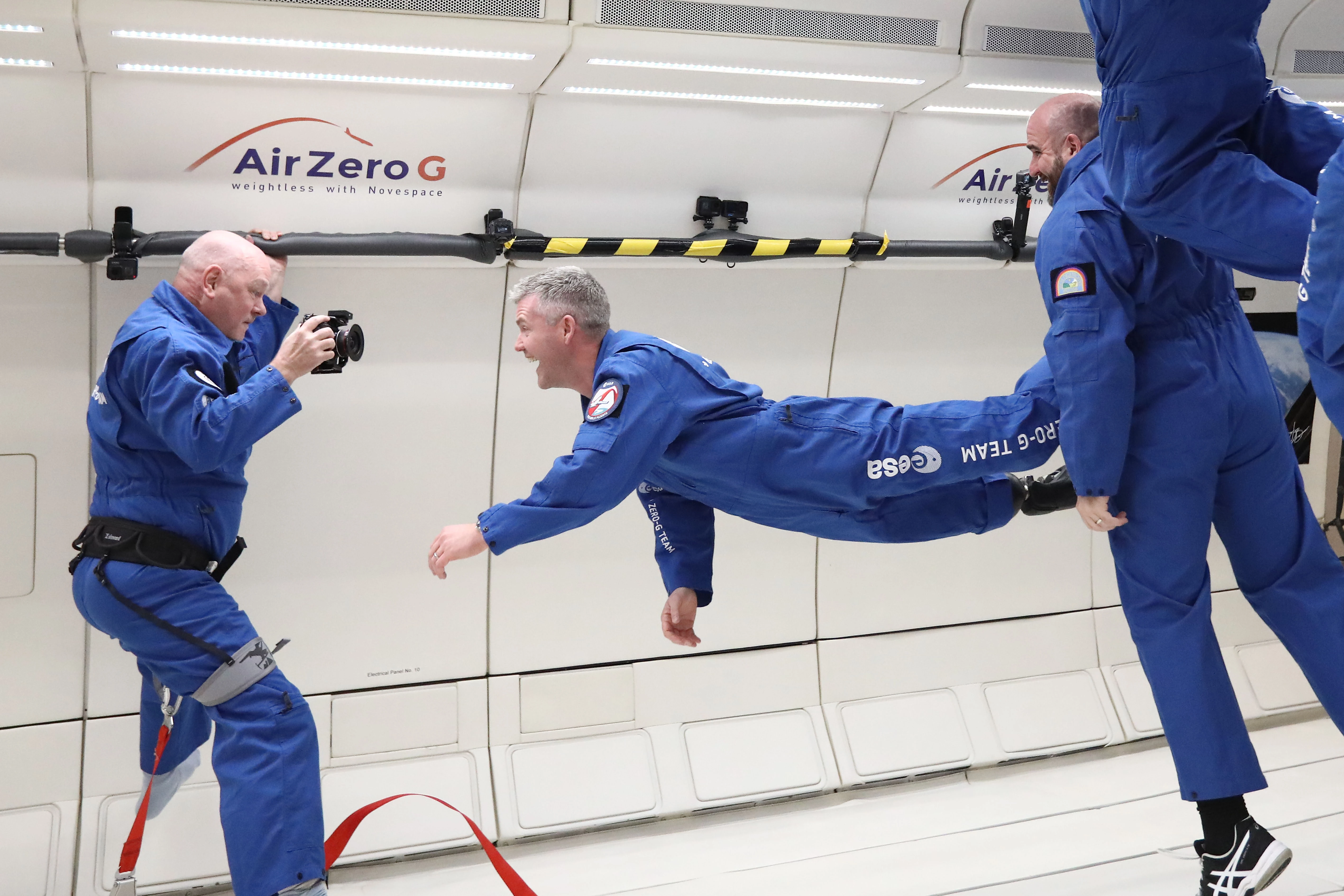
Prosthetics prepared for space.
John is working with Ottobock to ensure his prostheses are suitable for space exploration. Tests and dry runs are underway ahead of an upcoming parabolic flight campaign.
John shares, "On the parabolic flight campaign, we will be testing two prostheses—optimizing the setup of my running blade and testing it on a treadmill and evaluating the functionality of the microprocessor knee on my Genium X4. We're trying to understand how the sensors on my X4 will behave in a space environment and develop solutions for their functions in microgravity."
So why are prosthetics necessary in space? John explains:"The main reason I'd need to wear a prosthesis in space is for physical exercise. Staying fit is crucial during long-duration missions, and regular exercise is essential, such as using treadmills, weight training, etc."
The collaboration aims to create the right conditions for him to be fully prepared—prosthetically and physically—if assigned a mission.
While John hasn't yet been assigned to a space mission, the ESA's goal is clear: to prove that astronauts with disabilities can perform just as capably as other crew members—and to open opportunities to work in space for everyone.
John hopes all his work helps shift perceptions, not just in aerospace but across every industry! You can follow John's extraordinary astronaut journey on Instagram (here)