
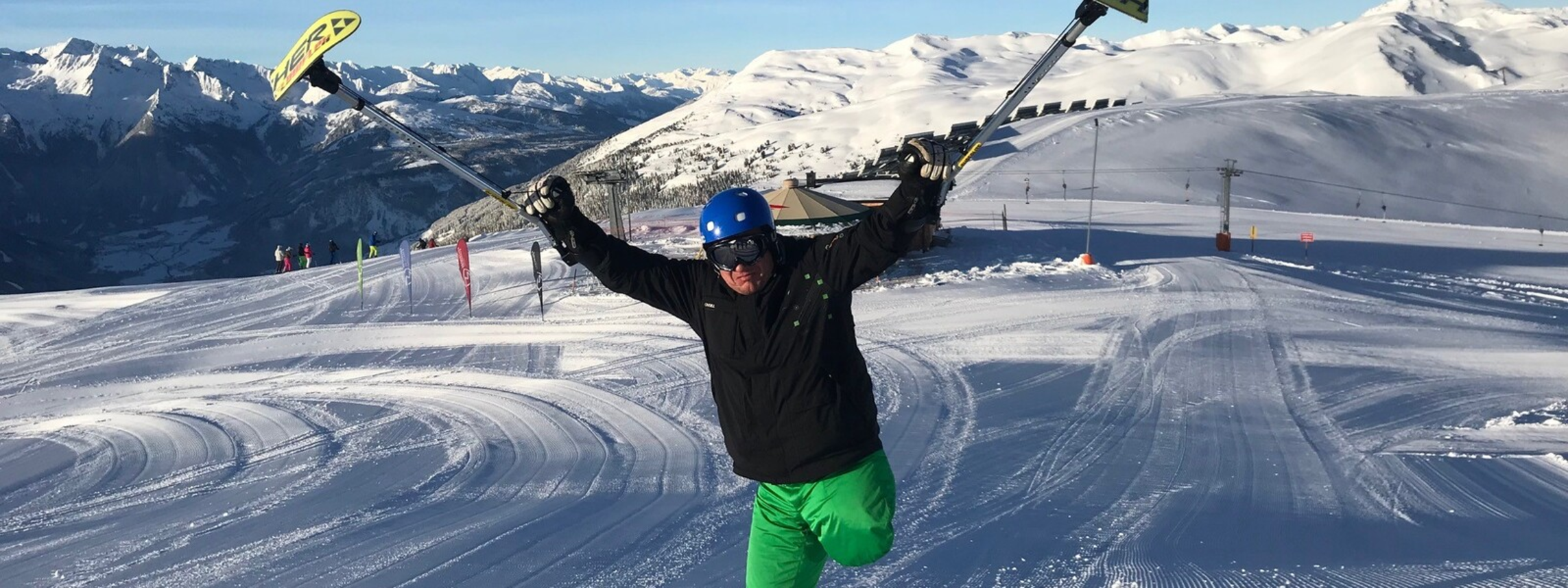
Mathias - Skiing on one leg
I've had an above-knee amputee since 1987 as a result of a motorcycle accident. I started skiing when I was 5 or 6 years old. So I was practically put on skis by my parents. So I was already skiing before the amputation and was always relatively active.
After my accident, things soon changed and I was able to ski in the Alps. As I'm from Leipzig, we have the Ore Mountains right on our doorstep, but the Alps were a bit of a lure. Of course, that was very appealing for us and my circle of friends more or less dragged me along.
I then tried to get down the mountain for the first time with normal forearm supports and on one ski, which of course wasn't that easy. I am a transfemoral amputee and have a fairly short residual limb, which is why I can only really use one ski for skiing. This is no longer a problem, I now have crutch skis, i.e. metal forearm supports that are relatively firm with short skis at the bottom, which I then use to support myself.
By chance, I met an older gentleman in Sölden who was also an amputee and lent me these crutch skis for the week. That was great, I was simply supposed to return them to the hotel when I left and of course had much more fun than with the normal forearm supports. This also led me to the source where I could get these accessories. At the time, it was through a medical supply store in Austria that specialized in equipment for winter sports. They also make these seat shells for wheelchair users and things like that.
A skiing vacation like that requires a bit of preparation and special equipment if you want to have fun. Not every ski fits, you should take a carving ski so that you can keep on track. Of course, you can also rent something and simply try out what you get on with best.
You can also ski on two skis, i.e. with a prosthesis. However, you then also need a fitting that makes this possible. There are also specific prostheses for this. However, the higher the amputee is, the more difficult it is to hold the prosthesis. It is helpful to choose a shorter ski on the prosthesis side. This makes it easier to steer the ski and make turns. If you want to be sporty and active here and perhaps not just ski small hills, you not only need the right equipment, but also a lot of practice. I certainly benefited from the fact that I could already ski, but it's the same with so many things: some people like it more, others less. You just have to find out how you feel and have the most fun.
I usually leave the prosthesis in my accommodation or in the car and then go to the lift with the crutch skis. You can fold up the short skis and walk a few meters to the lift with them. It's quite strenuous, but luckily you hardly ever have to wait at the gondola. The lifts often have a side entrance for ski schools or similar, where you don't have to queue. The lift operators are usually very accommodating and I've never had any problems. That's a nice thing, of course. What's more, you can often get discounts on ski passes for yourself and often also for an accompanying person if you have registered one. So it's best not to buy the passes online in advance, but to ask for possible discounts at the ticket office.
I prefer to ski above the tree line because the snow conditions are usually better there. I like a well-prepared, firm slope. As soon as the snow thaws and becomes slushy, it becomes very strenuous. Just like deep snow skiing is unfortunately not possible for me. I can do it for a bit, but as soon as I come to a standstill, I can't get going again. That's why I always try to get to the slopes early so that I can ski when the snow is still nice and the slopes are groomed. After the lunch break, I usually only ski 2-3 more times and then I usually call it a day. If the snow isn't as good as it used to be, it gets exhausting and isn't as much fun. Of course, this also makes it easier for accidents to happen.
Perhaps a few words about equipment...
If you are an active skier, there are also manufacturers who will provide you with individual skis, such as Völkl or Head, for example. You can ask for them. However, I've actually always taken a pair the last few times because it's cheaper in the end if you ski one ski for three seasons and then the other. You also really have to make sure that you have a sensible boot, you just have to try them out, they should fit really well. Because nothing is worse if you're really only skiing on one leg when the boot is pinching, you simply can't stand it all day long.